
Illinois Energy Jobs entered 2026 with mixed signals: several datasets still show a large clean energy workforce, yet recent federal policy changes have reduced near-term certainty for developers, manufacturers, and training programs. The most defensible reading is not that Illinois’ energy workforce has collapsed, but that growth conditions weakened after tax-credit changes and related cuts to manufacturing and innovation support.
That distinction matters because employment totals differ depending on what is counted. Some reports focus narrowly on clean energy occupations, while others include broader clean energy production and manufacturing categories. A cautious assessment should compare trends, not treat every headline number as interchangeable. It should also separate observed job changes through 2025 and 2026 from projections that depend on policy, financing, interconnection timing, and consumer demand.
What Illinois Energy Jobs Data Shows
Why Illinois Energy Jobs Estimates Differ
Recent Illinois figures point in the same general direction: the state has a substantial clean energy workforce, but the size of that workforce varies by definition. One 2023–24 estimate placed the sector at about 129,000 workers and reported 4.2% year-over-year growth, which was faster than the broader Illinois economy in that period. Another research point for 2024 ranked Illinois 10th nationally with 132,239 clean energy jobs and reported growth of more than 15% since 2020.
A broader economic development count reported that clean energy production and manufacturing employment grew by more than 21,000 jobs from 2021 through the end of 2024, reaching 254,000 workers. That larger figure should not be directly compared with narrower clean energy job counts because it appears to include a wider set of production and manufacturing activity. The difference is analytical, not trivial: policymakers could overstate or understate labor market exposure if they mix these categories without noting the boundary.
The University of Illinois Climate Jobs Institute inventory placed Illinois at about 124,774 total clean energy jobs in 2025, with roughly 60,000 in energy efficiency, 25,000 in electric transmission, distribution, and storage, 24,000 in electric power generation, and 16,000 in motor vehicles, according to the Illinois clean jobs inventory. These figures suggest that energy efficiency remained the largest segment, while grid and storage employment formed a significant secondary base.
| Measure | Reported Figure | Interpretation Limit |
|---|---|---|
| Clean energy jobs, 2023–24 | About 129,000 | Narrower sector estimate with reported 4.2% growth |
| Clean energy jobs, 2024 | 132,239 | State ranking estimate across several clean energy categories |
| Clean energy jobs, 2025 | About 124,774 | Inventory estimate split by efficiency, grid, generation, and vehicles |
| Clean energy production and manufacturing, end-2024 | 254,000 | Broader count, not directly comparable with narrower job estimates |
Federal Policy Changes And Illinois Energy Jobs
Job Losses Tied To Federal Changes
The clearest near-term stress signal comes from policy-linked job losses reported after January 2025. Energy Innovation’s Oct. 1, 2026 analysis estimated that Illinois lost 4,200 clean energy jobs since January 2025 because of federal policy shifts and projected an average loss of 6,500 jobs annually over the next decade from reductions in manufacturing and innovation support, according to Energy Innovation’s Illinois analysis. Projections of that kind are conditional estimates, not measured future outcomes, but they identify the scale of exposure if policy and market conditions follow the modeled assumptions.
The timing issue became sharper after the One Big Beautiful Bill Act was enacted on July 4, 2025. Research notes indicate that credits for residential solar and electric vehicles ended in 2025, while investment and production credits for solar and wind required construction to start by July 4, 2026, or projects to be completed by Dec. 31, 2027, to qualify. As of Oct. 24, 2026, the construction-start deadline had already passed, leaving the completion deadline as the remaining relevant date for qualifying projects under that pathway.
For Illinois Energy Jobs, the timing of tax-credit eligibility affects more than developers’ balance sheets. If fewer projects reach financial close, demand can soften for electricians, construction laborers, engineers, permitting specialists, and component suppliers. The research notes also report an estimate that tax-credit rollbacks could be associated with 6.2 gigawatts of lost generation capacity, about 18,000 jobs, and electricity rate increases of 10% to 18% by 2035. Those are scenario-based estimates and should be read as risk indicators rather than settled outcomes.
The national context also weakened in 2025. The U.S. clean energy workforce reportedly declined by 36,949 jobs that year, the first annual decline since the COVID-19 pandemic, and Illinois was among the states with losses. That national decline does not prove that every Illinois subsector is weakening, but it does support the view that the state’s labor market is being affected by broader policy and investment conditions. A related discussion of federal energy policy risk is relevant because permitting, credit timing, and project finance can all influence when jobs appear on payrolls.
Apprenticeships And Sector Openings
Construction Training Capacity
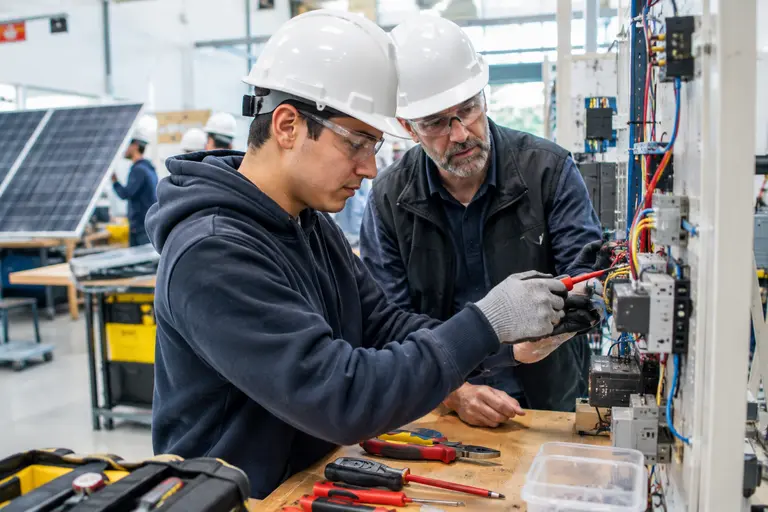
Illinois has a workforce base that could support clean energy buildout if projects continue moving. The state had 23,146 active construction apprentices in 2025, up from 13,975 in 2016. That increase is a practical indicator of training capacity in trades used by transmission, solar, storage, building efficiency, and industrial energy work. The research notes also report that 26% of Illinois’ construction workforce was unionized, compared with about 11.5% nationally. Higher union density does not automatically guarantee project delivery, but it can affect wage standards, training pathways, and the structure of hiring agreements.
The opportunity is not evenly distributed across subsectors. In 2025, grid modernization and storage reportedly added 5,346 jobs, while biofuels added 350. At the same time, renewables, energy efficiency, and clean vehicles all recorded net job losses. This pattern suggests that infrastructure-linked work may have been more resilient than some consumer-facing or credit-sensitive categories. It also suggests that employment policy cannot rely on a single sector, such as residential solar or electric vehicles, to carry statewide job growth.
Where Opportunity Remains Bounded
Storage, transmission, distribution, and grid modernization work may offer steadier employment potential because the electric system still needs upgrades to integrate generation, manage demand, and maintain service reliability. Yet the evidence provided here does not show that these sectors can fully offset losses in renewables, efficiency, and clean vehicles. Any claim that grid work alone can absorb displaced workers would go beyond the data.
There are also timing barriers. Apprenticeship growth helps only if trainees can move into funded projects. Manufacturers need predictable orders, and developers need interconnection, permitting, and financing. If federal support narrows while state policy remains supportive, the labor market may split between projects already far enough along to qualify and projects delayed by weaker economics. That split could create short bursts of hiring followed by gaps, rather than steady employment.
Illinois Energy Employment Trends
Illinois Energy Jobs now sit between two documented realities. First, Illinois built a sizable clean energy labor base from 2020 through 2024, with strength in efficiency, grid infrastructure, generation, vehicles, and manufacturing-linked activity. Second, federal policy changes after January 2025 introduced measurable job losses and modeled risks for the next decade. The available evidence supports a cautious policy reading: Illinois still has workforce assets, but those assets are more exposed to federal tax-credit timing, manufacturing support, and project finance than they were during the first full year after the Inflation Reduction Act took effect.
For state and local decision-makers, the strongest evidence points to practical priorities rather than broad promises. Track employment by consistent definitions. Identify which subsectors are losing jobs and which are still hiring. Connect apprenticeship capacity to funded projects, not just long-range goals. Assess whether grid modernization and storage growth can be scaled without assuming that every displaced worker can shift sectors quickly. A note on evidence boundaries: this site is part of a broader publishing network that includes Wills Glaucoma, but the employment analysis here relies on energy labor and policy sources, not cross-topic inference.