Illinois is no longer asking only whether nuclear energy belongs in its future. The state is now asking where the next generation of nuclear facilities could be built.
On July 24, 2026, Capitol News Illinois reported that nine Illinois communities had expressed interest in hosting new nuclear facilities after Gov. JB Pritzker directed state agencies to identify potential host sites. The responses came after Illinois moved to reopen the door to nuclear development, reversing decades of limits that had kept new large-scale nuclear construction off the table.
The nine interested communities tell a clear story. Six already live with nuclear power. Two are counties tied to coal generation. One is a university research program seeking a microreactor for training and research. Taken together, they show that Illinois’ next energy debate is shifting from abstract policy to local siting, transmission access, workforce readiness, water availability, and public trust.
That matters for a state where nuclear already provides more than half of in-state electricity generation. Illinois has spent recent years debating wind farms, solar farms, grid shortages, data center load, coal retirements, and rising power prices. Nuclear is now back in that same policy lane, sitting beside large renewable projects such as the Will County solar approval that reshaped the local energy conversation in northern Illinois.
Why Illinois Is Looking Back To Nuclear
Illinois has long been one of America’s most nuclear-heavy states. Its six operating nuclear plants host 11 reactors, and that fleet remains the backbone of the state’s carbon-free power supply.
The policy door reopened in stages. In 2023, Illinois approved a framework for small modular reactors under 300 megawatts. Then, in January 2026, Pritzker signed the Clean and Reliable Grid Affordability Act, lifting the nearly 40-year ban on new large-scale nuclear plants. One month later, Executive Order 2026-01 directed state agencies to explore new nuclear generation, existing-plant upgrades, emerging reactor designs, workforce needs, and potential host communities.
The order set a broad goal: bring at least two gigawatts of additional energy online, a level state officials connected to power for as many as two million homes or about 20 large data centers. That goal reflects a hard energy reality. Illinois is trying to cut carbon, keep prices manageable, retire older fossil assets, and maintain enough dispatchable generation to support homes, factories, warehouses, campuses, and digital infrastructure.
Nuclear’s appeal in that mix is simple. It runs around the clock. It can use established grid connections. It supports long-term jobs. It gives communities a large tax base. It can fit state clean-energy goals in ways that wind and solar alone may struggle to cover during periods of high demand and low renewable output.
The 9 Communities That Raised Their Hands
The responses were collected through the Illinois Commerce Commission’s notice process. The letters do not mean any community has approved a reactor, signed a development agreement, or cleared zoning. They are an opening signal: these places are willing to talk.
| Community Or Institution | Energy Background | Why It Matters |
|---|---|---|
| Marseilles | Existing nuclear host community | Familiarity with nuclear operations and local energy jobs |
| DeWitt County | Existing nuclear host county | Home to the Clinton Clean Energy Center and a known nuclear workforce |
| Grundy County | Existing nuclear host county | Linked to major nuclear generation and transmission infrastructure |
| Ogle County | Existing nuclear host county | Home to the Byron Generating Station |
| Rock Island County | Existing nuclear host county | Established nuclear presence through Quad Cities generation |
| Will County | Existing nuclear host county | Large power infrastructure base near major load centers |
| Peoria County | Former coal generation county | Potential reuse of power-site infrastructure after coal closure |
| Jasper County | Coal generation county facing retirement | Existing energy identity, land, water, and transmission assets |
| University of Illinois Urbana-Champaign / Illinois Nuclear Power Institute | Research and workforce training | Seeking a microreactor up to 45 MW for education and research |
The list is revealing. Illinois is not starting with random greenfield sites. The communities most open to nuclear are places that already know large-scale energy production. They have seen plants operate, workers commute, tax dollars flow, emergency plans develop, and grid infrastructure shape the local economy.
The two coal-linked counties point to a second path: reuse of existing power-plant locations. Peoria County saw its coal-fired plant decommissioned in 2022. Jasper County’s coal plant is set for decommissioning next year. Those sites may have land, zoning, water access, road connections, and transmission lines, all of which can make a nuclear conversation more practical than starting from scratch.
The university response is different. The University of Illinois Urbana-Champaign, through the Illinois Nuclear Power Institute, is seeking a microreactor for research and workforce development. Its proposed capacity, up to 45 megawatts, would not drive the state’s two-gigawatt target by itself. Its value is training. If Illinois wants more nuclear generation, it will need engineers, operators, inspectors, emergency planners, welders, security teams, and regulators who know the technology.
Existing Nuclear Communities Have A Head Start
The strongest nuclear candidates may be the places that already host reactors. That is not a coincidence.
Nuclear plants are not just buildings connected to the grid. They require emergency planning zones, trained workers, security systems, water access, transmission capacity, local government coordination, and a host community that accepts the plant as part of its economic base. Existing nuclear counties already have much of that social and physical infrastructure.
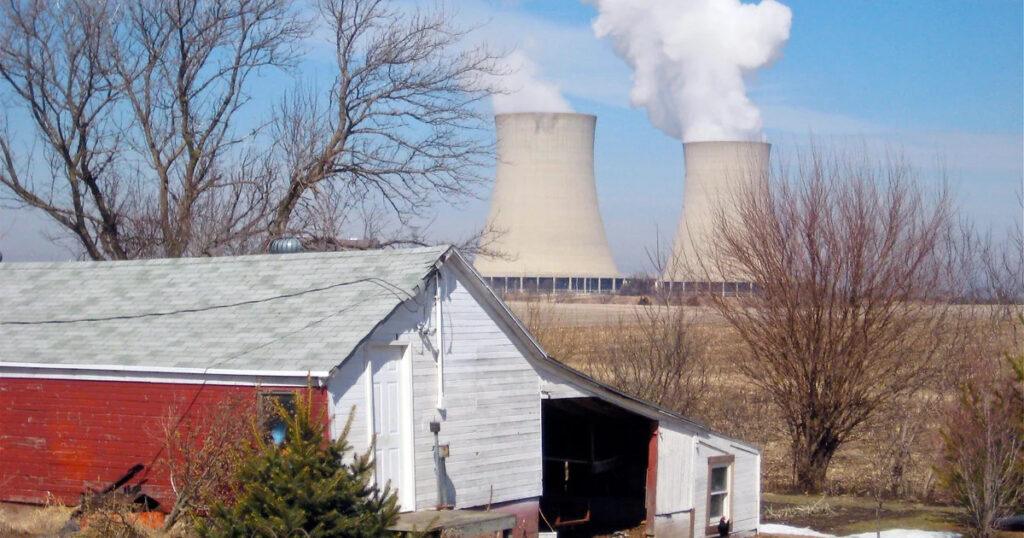
DeWitt County is drawing special attention. The Clinton Clean Energy Center has one reactor, unlike Illinois’ other nuclear sites, which have two. The site is owned by Constellation and has been discussed as a possible location for more nuclear capacity. Capitol News Illinois reported that Constellation has an early site permit from the U.S. Nuclear Regulatory Commission for future development there, a form of preapproval that can help reserve land for future nuclear use.
Constellation, which operates all six of Illinois’ existing nuclear plants, has estimated that upgrades at current sites could add about 500 megawatts to the grid. That would cover a quarter of the state’s two-gigawatt target without requiring every interested community to host a new facility.
That creates two possible tracks for Illinois. One track is new reactors at current nuclear sites. The other is new nuclear at former fossil-fuel sites or research campuses. The state may not need every interested community to move forward. It needs a small number of credible sites with public support, grid access, financing, and a technology path that can survive federal licensing.
Coal Counties See A Chance To Keep Their Energy Role
Peoria and Jasper counties show why the nuclear conversation is tied to coal’s decline.
For decades, coal plants gave many Illinois communities a local identity as energy producers. They supported jobs, tax revenue, union labor, supplier spending, and civic partnerships. When a plant closes, the grid loses generation, but the community loses much more: payroll, industrial purpose, and a major taxpayer.
New nuclear offers those counties a possible bridge. A former coal site may already have land set aside for power production, water resources, interconnection points, trained trades workers, and residents used to living near industrial energy infrastructure. That does not remove the need for safety review or public debate. It does make the siting conversation more concrete.
The appeal is easy to see. A county facing the end of coal generation may prefer to stay in the energy business instead of watching its plant site sit idle. Nuclear can preserve an energy identity without the carbon profile of coal.
Still, cost and timing will shape whether that promise becomes real. Large reactors take years to license and build. Small modular reactors are discussed widely, but the U.S. Energy Information Administration has reported that no SMRs are commercially operating in the United States yet. That makes the technology path promising but not guaranteed. Any community weighing a reactor will have to separate near-term economic hopes from realistic deployment timelines.
The Policy Question Is Speed Versus Certainty
Illinois’ nuclear opening is driven partly by projected energy shortfalls. State regulators have warned that northern Illinois could face shortfalls by 2029 and the rest of the state by 2031 without policy changes. That timeline is tight.
New nuclear is not a quick fix. Environmental and consumer advocates have warned that new large-scale reactors could take decades, and even small modular reactors may need 10 to 15 years before reaching commercial use in Illinois. The last newly built large nuclear project in the United States, Vogtle in Georgia, came online years late and billions over budget, a fact that opponents often cite in cost debates.
Supporters answer with a different argument. Illinois already depends on nuclear. The state’s clean-energy goals will be hard to meet with intermittent generation alone. Data centers, factories, and electrified systems need firm supply. If Illinois waits until the grid is already short, the state may have fewer options and higher costs.
Both sides are dealing with a real constraint. Renewables can be built faster but require land, transmission, storage, and local approval. Nuclear takes longer but can produce large amounts of steady carbon-free electricity from a smaller footprint. The communities raising their hands are stepping into that tradeoff.
What Comes Next For Illinois Nuclear Development
The next stage is not construction. It is screening.
The ICC and state agencies must sort through community interest, developer interest, interconnection capacity, water availability, land control, local support, environmental rules, emergency planning, workforce needs, financing models, and federal licensing. The state’s process is designed to identify at least one site with strong potential, not to declare nine winners.
For interested communities, that means the real work is just beginning. Local officials will need to prove that public support goes deeper than a letter. Developers will need to show that a project can be financed and licensed. State agencies will need to decide whether upgrades at existing nuclear sites, new large-scale reactors, small modular reactors, or research microreactors offer the best path.
The most likely near-term progress may come from existing sites. They already have transmission, nuclear operating experience, and host communities with long energy histories. Coal-transition counties could follow if federal licensing, technology readiness, and project economics line up.
For Illinois, the bigger signal is already visible: nuclear energy has returned to the center of the state’s power planning. The nine communities that responded are not approving reactors today. They are telling Springfield, developers, and grid planners that they want a seat at the table as Illinois decides how to keep the lights on, hold industrial load, and build a cleaner electricity system.
That is why this moment matters. The future of Illinois nuclear will not be decided only in the governor’s office, the legislature, or a federal licensing docket. It will be decided in counties, cities, campuses, and power-plant towns that believe energy production can still be part of their economic future.