
AI Arcing Detection is gaining attention because wildfire risk on electric systems can begin with subtle grid behavior that conventional protection equipment may not identify early. Oak Ridge National Laboratory has developed an AI-enhanced platform to recognize abnormal power grid conditions, especially low-current electrical arcing, and to alert utilities to signals associated with wildfire ignition risk, equipment damage, and outages. The work is promising, but it remains best understood as a field-data validation and demonstration effort rather than a proven utility-wide prevention system.
The issue is operational as much as technological. Electrical arcing can be low in current and difficult to separate from ordinary switching or equipment activity. Utilities need warning systems that identify real hazards without overwhelming operators with unclear alarms. That requirement makes the evidence base especially important. ORNL’s research points to measurable signal detection gains and broader event classification, while also showing why deployment depends on utility data quality, sensor placement, operator workflows, and validation in wildfire-prone service areas.
AI Arcing Detection In ORNL Grid Research
ORNL describes its platform as an AI-enhanced set of tools that uses signal processing and machine learning to detect abnormal grid behaviors and automatically alert utilities. The system has focused on low-current arcing because these events can be difficult to identify before they become safety or reliability problems. According to ORNL, the platform is being validated with five years of field-collected data from Southern California Edison, a utility with service territory exposed to wildfire conditions; ORNL reported that its algorithms amplified waveform signals revealing grid disturbances from about 6% to 72% in a real utility-data test, making previously subtle anomalies easier to detect ORNL reported.
How AI Arcing Detection Separates Subtle Faults
The technical premise is not simply that a machine-learning model watches for one type of problem. ORNL’s framework classifies seven types of grid disturbances: electrical arcing, including low-current events; overcurrent faults; blown fuses; motor starts; capacitor switching; short-lived faults; and recloser operations. That distinction matters because grid operators need to know whether a signal reflects a dangerous condition or a normal system operation. For utilities, AI Arcing Detection has value only if it can support decisions without confusing maintenance events, switching behavior, and fault signatures.
ORNL’s Grid Event Signature Library is another relevant part of the evidence base. The repository includes more than 5,700 waveform signatures associated with different grid behaviors, including arcing. A larger and better-labeled library can help train and test AI and machine-learning models, although the research notes do not provide a public, utility-wide accuracy rate, false-alarm rate, or missed-detection rate. Those gaps do not negate the research, but they limit what can be claimed about operational performance across different utilities, equipment ages, terrain, and weather conditions.
What The AWARE Platform Detects
ORNL’s technology is named AWARE, short for “Multi-Event Arcing Detection and Classification for Advanced Grid Resiliency and Wildfire Prevention.” The platform is intended to detect, classify, and report subtle disturbances that may be missed by conventional systems. In June 2026, ORNL and Southern California Edison began demonstrating abnormal detection and classification capabilities using AWARE, moving the work from lab development toward grid deployment. On August 14, 2026, the platform won a bronze R&D100 “Market Disruptor” award for utility in wildfire prevention, grid reliability, and decision-support operational tools.
Detected Grid Events And Operator Use
The practical value of AI Arcing Detection depends on whether operators receive timely and interpretable information. A detection signal is not the same as an emergency order; it must fit into utility procedures for inspection, switching, vegetation management, and outage response. AWARE’s stated purpose is to produce early warning and actionable reports, but the available research summary does not state how utilities would rank alarms by risk, how quickly crews would be dispatched, or how the system would perform during high-wind or high-load conditions.
- Electrical arcing, including low-current arcing that may be difficult to detect with conventional systems.
- Overcurrent faults, blown fuses, short-lived faults, and recloser operations that can affect reliability analysis.
- Motor starts and capacitor switching, which may resemble disturbance signatures but can be normal grid activity.
Why Signal Strength Is Not The Same As Prevention
The reported increase in waveform signal visibility from about 6% to 72% is significant as a detection result, but it should not be read as a wildfire reduction percentage. Signal enhancement can help reveal grid disturbances that would otherwise be difficult to identify. Fire prevention, by contrast, also depends on weather, vegetation, equipment condition, line routing, field response time, and whether operators can safely act on alerts. The value of AI Arcing Detection is strongest when framed as earlier situational awareness, not as a stand-alone guarantee that ignitions will be avoided.
Field Data, Drones, And Implementation Limits
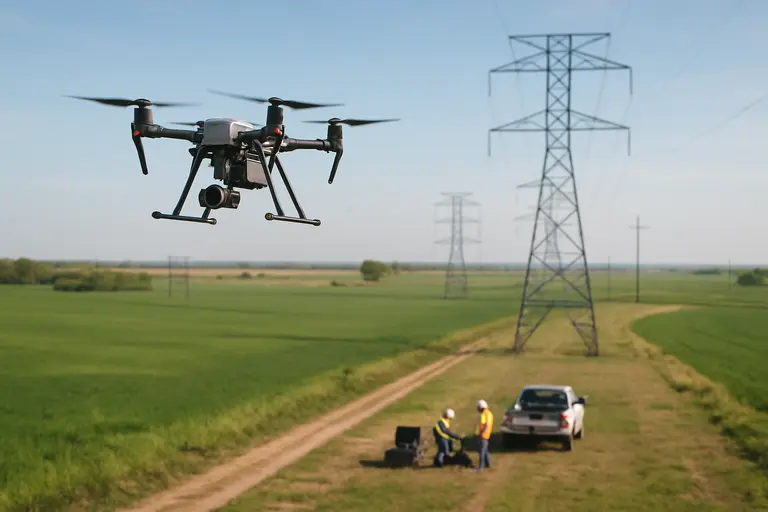
ORNL’s wildfire-related research also includes sensor systems for field inspection. Drone-mounted systems under development combine thermal imaging, visual cameras, audio, and radio-frequency sensors to detect arcing and overheating equipment in remote or rugged terrain. This approach is relevant where ground inspection is slow or where terrain, vegetation, or visibility limits human access. For readers interested in a broader technical context that encompasses energy and industrial systems, Mengo Industrial offers insights into related innovation areas within the network.
Funding And Test Infrastructure
The U.S. Department of Energy announced about $2.25 million in support for wildfire technology projects led by ORNL, including high-fidelity sensors to capture early grid signatures of arcing, libraries of arcing fault signatures, and drones for transmission-line inspection and vegetation-risk assessment DOE announced. ORNL’s Grid Operations and Analytics Laboratory supports this type of work with unmanned aerial systems, replicated utility command centers, real-time data feeds, edge computing, and machine-learning-enabled sensors. That test environment can reduce deployment risk, but it does not replace extended utility operation under varied field conditions.
Cost, Safety, And Deployment Questions
The research notes identify the DOE funding amount, but they do not provide full utility deployment costs, maintenance costs, communications requirements, or staffing needs. These omissions matter. A utility would need to integrate sensors, data streams, alert logic, cybersecurity controls, and crew response procedures. Safety rules would also govern how drones operate near energized equipment and how operators respond to a suspected arcing event. The technology appears to be demonstration-stage and field-data validated, not yet documented as a widely commercialized system with published performance across many service territories.
AI Arcing Detection For Wildfire Risk
AI Arcing Detection should be viewed as a targeted tool for grid risk reduction rather than a complete wildfire strategy. ORNL’s work shows that signal processing and machine learning can reveal disturbances that are hard to see in raw waveform data, and the use of five years of Southern California Edison field data gives the project more practical grounding than a lab-only model. The key limits are also clear: public materials do not yet provide broad accuracy metrics, cost ranges, long-duration deployment results, or quantified wildfire reduction outcomes. For utilities and regulators, the near-term question is whether systems like AWARE can improve inspection and operating decisions enough to justify integration into existing reliability and wildfire-mitigation programs.