
AI Renewable Energy adoption in Illinois is no longer just a research question. By late 2026, the state had examples ranging from a smart-home optimization study in Herrin to regional transmission organization pilots aimed at speeding interconnection studies. The evidence suggests that artificial intelligence can improve forecasting, scheduling, and study workflows, but it does not remove the need for transmission capacity, storage, project financing, and local acceptance.
Illinois already had a sizable renewable base before many of these AI applications reached public discussion. Research notes for the first quarter of 2025 listed 6,187 MW of installed solar, enough to power about 961,041 homes, with solar providing 2.87% of state electricity and more than $9.9 billion invested. On June 24, 2026, the Illinois Commerce Commission approved procurement of 1.55 GW of new utility-scale renewables, including three wind projects totaling 800 MW, four solar projects totaling 740 MW, and one hydropower project of about 10.26 MW. Those figures show why software improvements matter: the practical challenge is not only building projects, but connecting and operating them reliably.
What AI Renewable Energy Evidence Shows
AI Renewable Energy In A Herrin Smart Home
A May 2025 study centered on a smart home in Herrin, Illinois used artificial neural networks to forecast solar irradiance, wind speed, ambient temperature, and demand. The system paired those forecasts with Mixed Integer Linear Programming, battery storage, solar panels, micro-wind turbines, and demand response devices. The reported result was a 29% reduction in energy costs and a payback period of about four years, according to an SIU thesis.
For Illinois policy, AI Renewable Energy evidence from a single smart-home study is useful but limited. It indicates that better short-term forecasting and optimized device scheduling can reduce costs under the modeled conditions. It does not prove that the same savings would occur across different homes, rate designs, weather years, appliance mixes, or distribution circuits. The study is best read as an applied demonstration of technical potential, not as a statewide savings estimate.
Utility-Scale Installation And Control Uses
The research record also points to utility-scale applications. The 346-MW Gibson City Solar Project reached commercial operation in September 2026 and used robotics and AI software from Gritt to automate part of installation, while SCADA controls supported grid operations. That is a field deployment rather than a lab concept, but the public data cited in the research does not isolate how much of the schedule, labor, or cost outcome came from AI software alone.
This distinction matters. Installation automation may reduce repetitive site work, and controls may support operational visibility, but neither function guarantees faster interconnection or higher renewable penetration. A large project still depends on site access, equipment supply, switchyard capacity, permitting, and transmission conditions. AI can assist parts of the project chain; it is not the full project chain.
AI Renewable Energy And Interconnection Studies
RTO Pilots In PJM And MISO
The clearest grid-planning use case appears in interconnection studies. Illinois’ 2025 Draft Renewable Energy Access Plan, published in October 2025, described work by regional transmission organizations using AI tools. PJM was collaborating with Google and Tapestry to streamline interconnection studies, while MISO found that Pearl Street Technologies’ SUGAR framework could be used confidently in DPP Phase 1 studies, according to the draft access plan.
These examples are significant because interconnection queues can delay renewable projects even after developers secure sites and financing. Faster screening and better study automation could help identify network constraints earlier. The cautious reading is that these pilots support process improvement; they do not by themselves create new transmission capacity or settle cost allocation disputes.
Utility Grid Planning Use Cases
Ameren Illinois’ 2028–2031 Grid Plan, filed around fall 2025 in the research notes, described potential use of AI in Distributed Energy Resource Management Systems for hosted capacity analysis, voltage regulation, and automated interconnection studies. The same plan also referenced pilots for anomaly detection, outage forecasting, asset health dashboards, load forecasting, and electrification forecasting.
Those functions fit the operational needs of a grid with more distributed solar, batteries, electric vehicles, and variable loads. Hosted capacity analysis can help show where new distributed resources may connect with fewer upgrades. Voltage regulation can become more difficult as two-way power flows grow. Yet these applications require data quality, utility model validation, cybersecurity controls, and regulatory review before they can be treated as routine planning tools.
Why The Adoption Question Is Larger Than Algorithms
Illinois’ renewable buildout is tied to storage and demand growth as much as software. Research notes show that Illinois targeted 600 MW of new utility-scale storage by 2030 through its first battery storage procurement auction under recent legislation, compared with 141 MW installed as of mid-2026. Storage is relevant because wind and solar output vary by hour and season, while customer demand does not always align with production. A related discussion of Illinois grid planning explains why flexible demand and storage are increasingly treated as reliability tools rather than optional add-ons.
Demand pressure is also material. The draft 2026 Long-Term Renewable Resources Procurement Plan, dated August 15, 2025 in the research notes, projected potential development of 2.5–3.4 GW of new solar and 3.3–3.5 GW of new wind projects in 2026, driven by commercial and industrial demand, including data center growth. A January 2026 analysis cited in the notes assumed that Illinois data center electricity capacity could rise from about 2.6 GW in 2025 to 5.8 GW by 2030 under a medium-demand scenario, or 7.2 GW under a high-growth scenario.
- AI forecasting can improve planning inputs, but the result depends on representative weather, load, and equipment data.
- AI-assisted interconnection studies may reduce staff time, but projects still face physical network limits.
- AI dispatch tools need storage, demand response, or controllable resources to act on forecast information.
These constraints do not weaken the case for AI tools. They define the boundary of what those tools can reasonably do. Software can improve timing, screening, and coordination, while hardware and market rules determine whether clean generation can serve load at the required hour.
Local Program Effects And Equity Questions
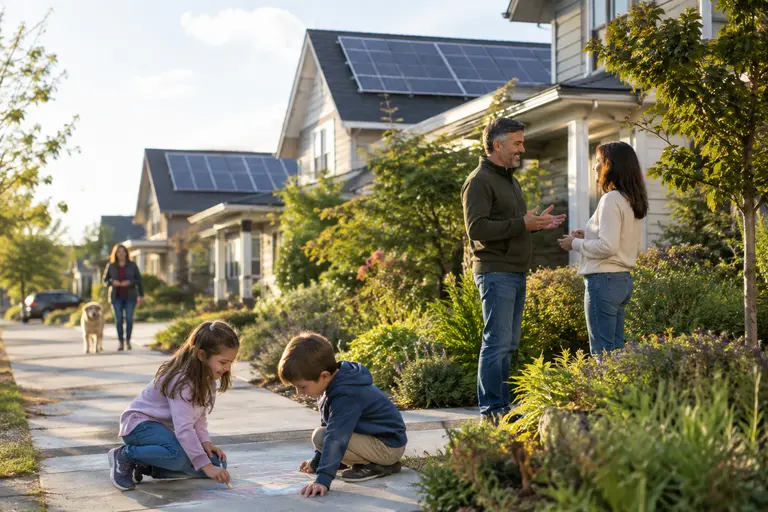
Illinois Solar for All had Program Year 2026 incentive funds of $43.4 million from the Renewable Energy Resources Fund, with another $20 million added in November 2025 based on the long-term plan, project data changes, and tax credit expirations. The research provided does not show that AI directly increased participation in that program. That is an evidence gap worth stating plainly, because low-income solar adoption depends on contractor availability, customer protections, building conditions, credit arrangements, and outreach, not only technical screening.
AI tools could support program administration if they are used to detect project bottlenecks or forecast budget needs, but that claim would require program-level evidence not included in the current research set. Public-facing analysis also matters because energy decisions affect bills, land use, and reliability; for more insights on public discussions about energy and infrastructure topics, LI Live Steam is a related site in the same network.
The equity question is practical: if automation speeds up interconnection for larger or better-resourced applicants but smaller community projects still face paperwork, financing, or site barriers, then software gains may not be evenly distributed. Illinois has enough program data to ask that question, but the available research does not yet answer it.
Illinois AI Renewable Energy Adoption
Illinois’ experience through November 5, 2026 supports a measured view of AI Renewable Energy deployment. The best-supported benefits are forecasting, optimization, study automation, anomaly detection, outage forecasting, and planning support. The strongest current evidence is not that AI replaces infrastructure, but that it can help planners and operators use infrastructure with better information.
The limits are just as clear. The Herrin smart-home study was localized. The RTO interconnection examples were pilots or process reforms, not proof that all queue delays will shrink. Utility plans describe intended and pilot uses that still require validation. The Gibson City project shows field use of robotics, AI software, and SCADA controls, but public evidence does not quantify the independent contribution of each tool.
For Illinois, the practical policy test is whether AI-assisted planning can be paired with storage procurement, transmission upgrades, transparent interconnection rules, and careful treatment of growing data center load. If those pieces align, AI can support renewable adoption. If they do not, better algorithms will still face the same physical grid constraints.